The 90-Day Window Around Every Job (and the 3 Postcards That Win It)
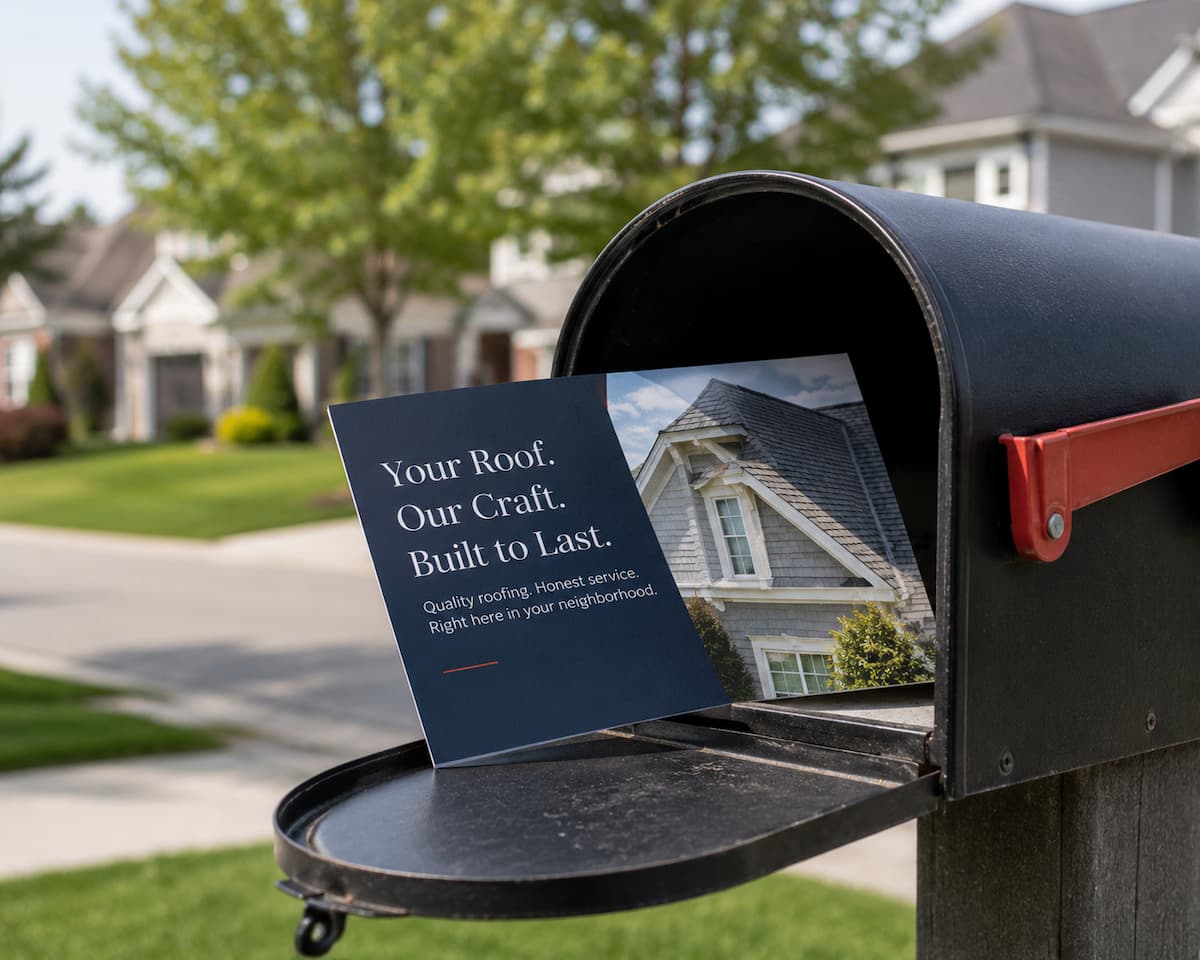


Every time you finish a job, a clock starts. For about 90 days, the homeowners on that block are the warmest leads you will ever get. They watched your trucks pull up. They saw your crew at the curb. They walked past the dumpster every morning. They have the same house, the same roof, the same age water heater as the neighbor who just paid you.
Most contractors walk away from that block and never look back. They go chase cold leads on Google. Then they wonder why marketing costs keep climbing.
The fix is a three-postcard sequence and a jobsite marketing system built around the job you already booked. Sent to the 25 to 50 closest neighbors. Pre-job, mid-job, post-job. Cheap to run, easy to track, and the math beats almost any digital channel a contractor uses.
What Is a Jobsite Neighbor Marketing Campaign?
A jobsite neighbor marketing campaign is a direct mail sequence sent to the 25 to 50 homeowners closest to an active or recently completed job. It typically runs three postcards over a 90-day window - one before the job starts, one when it wraps up, and one about a month later. Because the recipients already saw your work firsthand, response rates climb well above what you get from cold-list mail drops. It is one of the highest-return offline marketing tactics available to a home service contractor.
Why Neighbors Convert Faster Than Strangers
Direct mail to a cold prospect list pulls about 2.7 to 4.4 percent response for home services. That's already better than email (0.6 percent) and paid search (0.2 percent). Send the same piece to homes within two blocks of an active jobsite, and the response climbs again, because three things stack in your favor.
Proximity. Trees fall in the same storms. Sewer lines age out the same year. HVAC systems get installed in the same decade by the same builder. When you replace a water heater on one block, the rest of that block is on borrowed time.
Recency. A postcard from a roofer is forgettable. A postcard from the roofer whose trucks were parked at 412 Maple for three days is the opposite.
Social proof. The piece doesn't have to convince the neighbor that you do good work. They already saw it.
That's why one postcard mailed to the 50 nearest houses can outperform thousands mailed to a cold zip code.
The Single-Drop Trap
Here's where most contractors give up on print. They send one postcard. They get 0.5 percent response. They decide direct mail doesn't work. Print works. The problem is the drop count.
A 2025 study by Adzze on 10,000 home-service pieces showed an initial 1.8 percent immediate response. Over the following weeks, another 2.7 percent of households redeemed the offer. Total cumulative response: 4.5 percent. The second touch didn't cancel the first. It stacked on it.
Single-drop direct mail is a coin flip. A three-drop sequence over 90 days is a system.
The Three Postcards Every Contractor Should Send
Each piece has its own job. None of them ask the neighbor to call that minute. They build familiarity, then awareness, then a soft ask. By piece three, you are the obvious local choice on that block. Putting together the right contractor postcard design and printing is key.
Postcard 1: Pardon Our Noise
Send this 5 to 7 days before the crew shows up, to the 25 to 50 closest homes.
The tone is courteous and short. Something like: "Hi from your neighbors at [Company]. We'll be working at [address or general block] from Monday through Wednesday. You may notice some noise and trucks. If you have any questions, here's a direct number to our project lead."
This piece opens a door. The neighbor learns who you are before they ever see your truck. You also pick up goodwill on the block, which protects your jobsite if a homeowner ends up cranky about parking or noise.
Use a postcard with your logo, the project lead's direct line, and a small photo of the crew or a recent finished job. Small detail, big impact.
Postcard 2: Your Neighbor Chose Us
Send this on the last day of the job or within 48 hours of finishing.
This is the workhorse piece. The headline reads something like: "Your neighbor at [address or block, with the homeowner's okay] chose us to [service]. Since we're already in the area this week, we're offering free [inspection / estimate / quick consult] to the closest 25 homes. No pressure."
Two things make this piece work. Naming the address makes the social proof real. The "while we're in the area" line creates soft urgency. Contractors who run this consistently book one to three estimates for every twenty pieces, which is strong response in any channel.
If the homeowner won't let you name the address, use the block name or a landmark. "Your neighbor on the corner of Maple and 5th" still works.
Postcard 3: Still Thinking About It? (Follow-Up)
Send this 4 to 6 weeks after the job closes.
This is the soft follow-up most contractors skip. The neighbor saw your trucks a month ago. They've forgotten the address. They haven't forgotten that something got done over there. The piece reminds them.
The copy is simple. "Last month we completed a [service] near your home. If you've been thinking about [trigger: a leaky pipe, a noisy unit, missing shingles], we'd be glad to come take a look at no cost." Include a photo from the actual job and a QR code that goes to a short estimate form.
This piece is where the 2.7 percent of "delayed redemption" customers live. The homeowners who weren't ready in week one but are ready in week six.
Without piece three, that revenue never lands in your account.
How to Actually Run This Without Losing Your Mind
Three rules keep the sequence alive past month one.
- Build it into your job-close checklist. Same way photos and reviews are on the list, the three drops go on the list. If a job closes without piece one in the mail, the job isn't really closed.
- Pre-print postcards in bulk. Your printer can produce postcards with your branding, your photo, and your QR code, with blanks for the address and date you fill in per job. Footbridge Marketing handles exactly this kind of contractor print work - postcards, EDDM cards, doorhangers, business cards, and yard signs at contractor pricing.
- Track every piece. Put a different QR code or trackable phone number on each of the three postcards. Without that, you're guessing at what worked. With it, you can see exactly which drop is doing the heavy lifting and adjust the offer or design.
This is also worth tying into your broader local marketing stack. If you are already working on review generation and local SEO, the postcard sequence amplifies both - you are creating neighborhood name recognition that reinforces what people find when they search you online.
The Dollar Math Most Contractors Never Run
Let's put real numbers to this. Say you finish 80 jobs a year. You send 25 postcards per job, three times, at roughly $0.75 per piece all-in with printing and postage. That is less than $60.00 in print per job. Across 80 jobs, the full-year investment is about $4,500.
| Variable | Number |
|---|---|
| Jobs per year | 80 |
| Cards per job (3 drops x 25) | 75 |
| Cost per card (print + postage) | $0.75 |
| Total annual print spend | $4,500 |
| Cumulative response rate (3-drop sequence) | ~4% |
| Responses per job (approx. 1 per 25 cards) | ~1 |
| Jobs booked at 1-in-3 response conversion | ~27 |
| Revenue at $4,000 average ticket | ~$108,000 |
If your campaign averages a 4 percent cumulative response across the three drops, that's one response per job. Say one in three of those responses books a job at your average ticket. On a $5,000 service ticket, you've covered the entire year's print spend out of the first booked job and put over $100,000 in pipeline behind a $4,500 investment.
That's the math most contractors don't run, because they quit print years ago and never tested it with a real sequence. The channel still works. Which is exactly why it's quietly outperforming the channels everyone else is fighting over.
Start With The Next Job On The Calendar
You don't need a marketing department to run this. Three card designs, a printer, a list of the nearest 25 to 50 homes for each project, and a checklist that puts the drops on the job before the job is "done." That's it.
If you want help getting the cards designed, printed, and shipped to your shop, footbridgemarketing.com handles all of it. EDDM postcards, doorhangers, business cards, yard signs, and the trackable QR codes that turn a campaign into a measurable channel.
Your next job is also your next neighborhood campaign. Run it like one.
If you want help getting the infrastructure in place - from the print side to the digital follow-up that supports it - that's exactly the kind of full-picture marketing approach we build for contractors at Footbridge Media and Footbridge Marketing. Over 20 years working exclusively with home service businesses, and we still think the best-converting campaigns are the ones that combine what works offline with what works online.
Frequently Asked Questions
Most contractors start with the 25 to 50 homes closest to the job address. In a dense neighborhood, that might be everything within a block or two. In a rural or spread-out area, you may define proximity differently. The goal is homes where your crew was visible - neighbors who actually saw your trucks, your crew, or the work being done. That visibility is what separates these leads from a cold mailing list.
Yes - you should ask before naming a specific address in your "your neighbor chose us" postcard. Most homeowners are happy to say yes, especially if you did good work. If they decline, you can still reference the street name, a nearby landmark, or the general block ("your neighbor on the corner of Oak and 3rd") and get most of the social proof benefit without the specific address.
EDDM (Every Door Direct Mail) delivers to every address on a postal carrier route - it is a broad-reach option that works well for brand awareness across a whole zip code or neighborhood. A targeted jobsite neighbor mailing is much more specific: you are identifying the exact addresses closest to a job you just ran and mailing only those homes. The targeted approach costs a bit more per piece but produces significantly higher response because of the proximity and social proof factors built into the campaign.
Use a unique QR code or a unique trackable phone number on each of the three postcards. That way, when a lead comes in, you know exactly which drop triggered the call or form fill. Without this, you are guessing - and guessing makes it hard to improve the campaign over time or cut what is not working. Setting up call tracking numbers is inexpensive and worth it from the very first campaign you run.
The sequence works for any trade where the job is visible from the street and neighbors would plausibly need the same service. Roofing, siding, HVAC, plumbing, landscaping, painting, window replacement, driveway work - all strong fits. It works less well for interior-only work that neighbors would not have seen or for trades with very long purchase cycles. If your crew showed up, parked on the street, and made a visible change to the property, your neighbors noticed - and you should be marketing to them.


About Aaron O'Hanlon
Aaron O'Hanlon is the CEO and Co-Founder of Footbridge Media, a digital marketing agency, specializing in the contracting industry. It is his mission to create awareness of marketing online to the home improvement industry and to educate, inform, and assist contractors in taking over their own online presence.